
Los Angeles
History
Los Angeles coastal area was first settled by the Tongva (or Gabrieleños) and Chumash Native American tribes hundreds of years ago. The first Europeans arrived in 1542 under João Cabrilho, a Portuguese explorer who claimed the area as the City of God for the Spanish Empire; he continued with his voyage and did not establish a settlement.[5] The next contact would not come until 227 years later, when Gaspar de Portola, along with Franciscan missionary Juan Crespí, reached the present site of Los Angeles on August 2, 1769. Crespi noted that the site had the potential to be developed into a large settlement. In 1771, Franciscan friar Junípero Serra built the Mission San Gabriel Arcangel near Whittier Narrows, in what is now called San Gabriel Valley. In 1777, the new governor of California, Felipe de Neve, recommended to the viceroy of New Spain that the site noted by Juan Crespi be developed into a pueblo. The town was founded on September 4, 1781, by a group of 44 settlers and was named "El Pueblo de Nuestra Señora la Reina de los ángeles Del Río de Porciúncula" ("The Town of Our Lady the Queen of the Angels on the River Porciúncula"). These settlers were of Filipino, Native American, African, and Spanish ancestry, with two-thirds being mestizo or mulatto. A majority of the settlers had some African ancestry. The settlement remained a small ranch town for decades, but by 1820 the population had increased to about 650 residents.
Climate
The city is situated in a Mediterranean climate or Dry-Summer Subtropical zone (Köppen climate classification Csb on the coast, Csa inland), USDA Zones 8-11, experiencing mild, somewhat wet winters and warm to hot summers. The prevalent warm southerly airflow and the blocking effect of mountains to the north give the city a much warmer climate than would be expected. The average annual temperature is (around 66 °F), much higher than some comparable coastal locations at the same distance from the equator elsewhere such as Cape Town. Breezes from the Pacific Ocean tend to keep the beach communities of the Los Angeles area cooler in summer and warmer in winter than those further inland; summer temperatures can sometimes be as much as 18 °F warmer in the inland communities compared to that of the coastal communities. A few coastal "micro-climates" have never recorded a temperature below freezing. Coastal areas also see a phenomenon known as the "marine layer," a dense cloud cover caused by the proximity of the ocean that helps keep the temperatures cooler throughout the year. When the marine layer becomes more common and pervades farther inland during the months of May and June, it is called May Gray or June Gloom.
Economy
The economy of Los Angeles is driven by international trade, entertainment (television, motion pictures, recorded music), aerospace, technology, petroleum, fashion, apparel, and tourism. Los Angeles is also the largest manufacturing center in the United States. The contiguous ports of Los Angeles and Long Beach together comprise the most significant port in North America. They are one of the most important ports in the world, and vital to trade within the Pacific Rim. Other significant industries include media production, finance, telecommunications, law, health medicine, and transportation.
Until the mid-1990s, Los Angeles was home to many major financial institutions in the western United States. Mergers meant reporting to headquarters in other cities. For instance, First Interstate Bancorp merged with Wells Fargo in 1996, Great Western Bank merged with Washington Mutual in 1998, and Security Pacific Bank merged with Bank of America in 1992. Los Angeles was also home to the Pacific Exchange, until it closed in 2001. The city has six major Fortune 500 companies.
Courtesy: http://www.wikipedia.org/
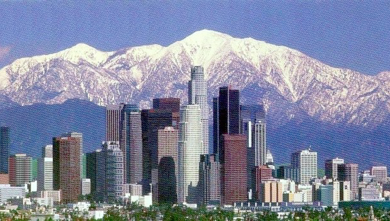
Welcome To Los Angeles, california USA
News and Sports, Movie, Music and Restaurant Reviews, Sports, Gas Prices, Maps And More...
This Site Is Funded By People Like You, Thank You!
© 2019 Anews1.com All Rights Reserved.